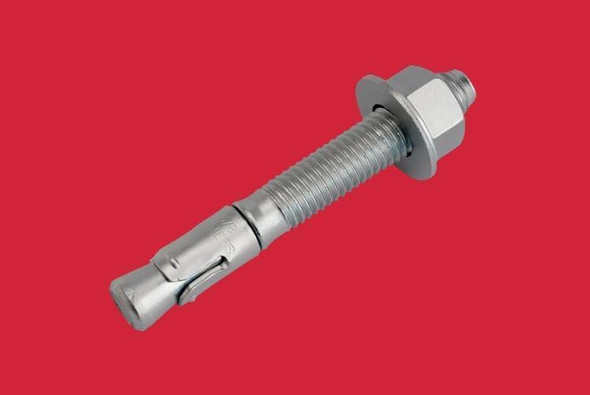
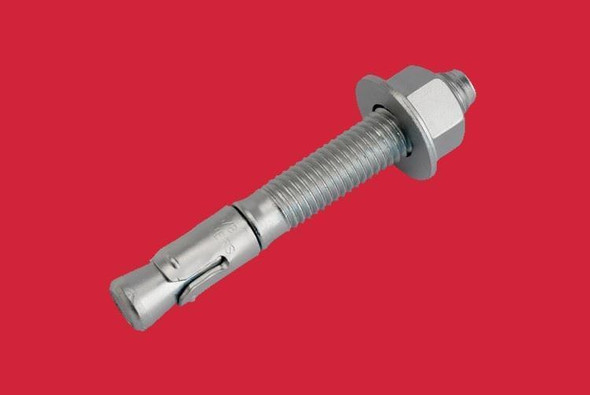
The concrete wedge anchor is an expansion type anchor used to anchor a fixture into solid concrete. The wedge anchor is made of two separate pieces permanently pre-assembled into a single unit. The main piece is a carbon steel rod that is threaded for a portion of its length. The un-threaded portion of the rod has a conical space that tapers outward back to the full diameter of the rod. The second piece of the wedge anchor is a steel clip that is permanently assembled around the conical section of the rod. Each wedge anchor also requires a nut and washer to complete the installation.
The wedge anchor is installed through the fixture into a pre-drilled hole. As the anchor is hammered into the hole, the clip is recessed in the gap of the conical space, allowing the anchor to penetrate the hole. The anchor is set by tightening the nut. As the nut is tightened, the rod is pulled up, making the clip move outward on the tapered space, thus wedging it against the wall of the hole. The wedge anchor, once installed, cannot be removed without damage to the surrounding concrete.
The wedge anchor can only be used in solid concrete, and not in brick or block base material. The wedge anchor can be used in a variety of applications, from light duty to heavy duty. Some common applications for the wedge anchor are fastening pallet racks to concrete, installing railing, mounting machinery to a floor, attaching framing to a concrete foundation..the list goes on and on.
Other common names for the wedge anchor are:
| Stud Anchor |
Kwik-bolt |
Thunderstud® |
| DFS wedge anchor |
Kwik-bolt 2 anchor |
Sup-r-stud |
| Redi bolt |
Hilti Kwik bolt |
Concrete stud anchor |
| Wedge all |
Kwik bolt |
Stud wedge anchor |
| Kingpin |
Power bolt |
Stud anchor system |
| Trubolt |
Power stud |
|
Concrete wedge anchors can be made from carbon steel or stainless steel. The carbon steel wedge anchor can be zinc plated or hot-dip galvanized. Stainless steel wedge anchors are available in 303 or 316 stainless.
Zinc plated carbon steel wedge anchors are the most common. The wedge anchor, clip, nut and washer are all made from zinc plated carbon steel. Although the zinc plating offers some corrosion resistance, these wedge anchors are generally used for interior applications only. Also, the zinc plated wedge anchor is not accepted for use in ACQ treated lumber.
Hot dip galvanized wedge anchors offer the next level of corrosion resistance. Hot dip galvanized wedge anchors are suited for use in exterior applications where corrosion from water or moisture is a concern. They can also be used in ACQ treated lumber. The wedge anchor, nut and washer are made from carbon steel that is then hot dip galvanized, and the clip is made from 303 stainless steel.
Stainless steel wedge anchors offer the highest level of corrosion resistance, and can be used in exterior applications. Wedge anchors made from 303 stainless steel are resistant to many organic and inorganic chemicals, but should not be used in a salt water environment. The anchor itself is made from 303 stainless steel, while the nut, washer and clip are made of 18-8 stainless steel (which is comparable to 303 stainless steel.) Wedge anchors made from 316 stainless steel offer the best corrosion resistance and can be used in the harshest environments, even salt water. All components of this wedge anchor are made from 316 stainless steel.
The wedge anchor is available in 9 diameters: 1/4", 5/16", 3/8", 1/2", 5/8", 3/4", 7/8", 1" and 1-1/4", and a wide range of lengths. Wedge anchors are also manufactured with different thread lengths. Some manufacturers prefer to offer a fully threaded wedge anchor, while others produce a partially threaded wedge anchor. There are pros and cons to both types of anchors and the question of which anchor is the better choice is still heavily debated among professionals in the industry.
The partially threaded wedge anchor is threaded for about a third of it's length. The diameter of the unthreaded portion is less than the nominal diameter. The foremost benefit of the partially threaded wedge anchor is that it cannot be successfully installed in a hole that does not meet or exceed minimum embedment requirements.
Determining the size of wedge anchor required for your application is a fairly simple process. Anchor diameter required is typically dependent upon the hole in the fixture itself. The length of wedge anchor required simply add the thickness of the fixture to be fastened to the minimum embedment for the wedge anchor diameter being used, plus the thickness of the nut and washer (approximately equal to the anchor diameter itself). So, consider you have a 1-3/4" thick fixture with a 7/8" hole. As indicated by the chart below, that would require a 3/4" diameter wedge anchor. A 3/4" diameter wedge anchor has a minimum embedment of 3-1/4". The length needed is simply figured:
| Thickness of Material |
(1-3/4") |
| +Minimum Embedment |
(3-1/4") |
| +Thickness of Nut/Washer |
(3/4") |
| =Minimum length of anchor |
(5-3/4") |
Installation of the concrete wedge anchor is not a complicated process. It is helpful to note that hole diameter is always equal to anchor diameter, and, furthermore, hole tolerance is crucial to the wedge anchor's performance. To achieve the proper hole, it is important to use a hammer drill with a carbide-tipped masonry bit. These bits are specifically designed for use in hammer drills and meet the necessary ANSI standards.
The first step for installation is to drill your hole (at least 1/4" deeper than minimum embedment, accommodating a minor amount of concrete cutting which may not be able to be cleaned out of the hole), ensuring you meet the minimum embedment requirements for the diameter wedge anchor you are using. Minimum embedment is approximately 4-1/2 bolt diameters. Before drilling your holes, be certain to consider that no anchor should be placed any less than five anchor diameters from an unsupported edge, and no less than ten anchor diameters apart. The forces generated by the wedge anchor are transferred to the concrete — if they are placed too close together, holding values can be diminished, or the concrete may be damaged.
| A |
1-1/2" |
2" |
N |
8" |
8-1/2" |
| B |
2" |
2-1/2" |
O |
8-1/2" |
9" |
| C |
2-1/2" |
3" |
P |
9" |
9-1/2" |
| D |
3" |
3-1/2" |
Q |
9-1/2" |
10" |
| E |
3-1/2" |
4" |
R |
10" |
11" |
| F |
4" |
4-1/2" |
S |
11" |
12" |
| G |
4-1/2" |
5" |
T |
12" |
13" |
| H |
5" |
5-1/2" |
U |
13" |
14" |
| I |
5-1/2" |
6" |
V |
14" |
15" |
| J |
6" |
6-1/2" |
W |
15" |
16" |
| K |
6-1/2" |
7" |
X |
16" |
17" |
| L |
7" |
7-1/2" |
Y |
17" |
18" |
| M |
7-1/2" |
8" |
|
|
|
Wedge anchors are an excellent choice for anchoring into concrete because of their exceptional holding values. The holding power of any anchor is always dependent upon the quality or strength of the concrete itself. The holding values are also based on the depth of embedment - the deeper the embedment, the better the holding values. When comparing technical data for different manufacturers, it is important to determine what values are being given - ultimate load ratings or working load ratings. Either term is acceptable, but it is important that when comparing products, equivalent values be used.
| Anchor Diameter (in.) |
Embed. Depth (in.) |
Torque Ft/Lb |
2000 PSI |
4000 PSI |
6000 PSI |
| Tension (LB) |
Shear (LB) |
Tension (LB) |
Shear (LB) |
Tension (LB) |
Shear (LB) |
| 1/4 |
1-1/8 |
5-10 |
1170 |
1443 |
1771 |
1813 |
2773 |
2635 |
| 1-3/4 |
1841 |
1443 |
2408 |
1813 |
2773 |
2635 |
| 2-3/4 |
1975 |
1443 |
2748 |
1813 |
2830 |
2635 |
| 3/8 |
1-1/2 |
25-30 |
1631 |
4318 |
3636 |
5121 |
4448 |
6232 |
| 3 |
3229 |
4318 |
5653 |
5121 |
5975 |
6232 |
| 5 |
4075 |
4318 |
6328 |
5121 |
6360 |
6232 |
| 1/2 |
2-1/4 |
50-60 |
3999 |
7419 |
6714 |
9377 |
9616 |
9888 |
| 4 |
6336 |
7419 |
8942 |
9377 |
10192 |
9888 |
| 6 |
6902 |
7419 |
10175 |
9377 |
12064 |
9888 |
| 5/8 |
3-3/4 |
75-90 |
4999 |
8264 |
8747 |
12928 |
9760 |
16373 |
| 5 |
8854 |
8264 |
15590 |
12928 |
19802 |
16373 |
| 7 |
9381 |
8264 |
16710 |
12928 |
17732 |
16373 |
| 3/4 |
3-1/4 |
150-175 |
6638 |
12504 |
11314 |
17050 |
16230 |
22965 |
| 6 |
10084 |
12504 |
18408 |
17050 |
21092 |
22965 |
| 8 |
11170 |
12504 |
19805 |
17050 |
22522 |
22965 |
| 7/8 |
3-7/8 |
200-250 |
8392 |
18250 |
16354 |
20234 |
16801 |
23980 |
| 5-3/4 |
12064 |
18250 |
18250 |
20234 |
23404 |
23980 |
| 8-3/4 |
12784 |
18250 |
16850 |
20234 |
25575 |
23980 |
| 1 |
4-1/2 |
250-300 |
9773 |
23617 |
18250 |
27605 |
27460 |
28909 |
| 7-1/2 |
11890 |
23617 |
26726 |
27605 |
34960 |
28909 |
| 10 |
15590 |
23617 |
30491 |
27605 |
37840 |
28909 |
| 1-1/4 |
5-1/2 |
400-450 |
17550 |
32275 |
22971 |
42690 |
32368 |
55566 |
| 7 |
21050 |
32275 |
27845 |
42690 |
48366 |
55566 |
| 10 |
27893 |
32275 |
34788 |
42690 |
61272 |
55566 |
Holding values shown above are ultimate holding values for the embedments shown. A safety factor of 4:1 (or 25%) is generally accepted as a safe working load. For example, if the ultimate shear load for a 1/2" dia. wedge anchor in 4000 psi concrete is 9377 lb., then the safe working load for that anchor is 2,344 lb. It is also important to remember that this value is the holding value for one anchor. If eight anchors will be used to anchor a fixture, the combined holding value would be 18,752 lb. (2,344 lb. X 8 anchors).
Although the wedge anchor can only be used in solid concrete, it is still a versatile anchor - available in a wide range of diameters and lengths and offered in zinc, hot-dipped galvanized and stainless steel for a variety of applications. This, combined with the its exceptional holding values make the wedge anchor an excellent choice for most fastening jobs.
Purchase Concrete Wedge Anchors
Please remember with all fastening jobs to keep safety in mind. Always follow safety instructions on all tools, and refer to manufacturer's installation instructions when available and always remember to wear safety goggles!
Article written by: Michael Pistorino, Concrete Fastener Specialist