

The SDS Carbide Tipped Drill Bit
What is a carbide tipped drill bit?
Whenever a post-installed concrete anchor is being used to attach a fixture to cured concrete, a hole must be drilled in the concrete. One popular type of drill bit that is used to drill into cured concrete is the SDS carbide tipped drill bit. SDS is simply the bit retention system — or how the bit is held in the drill. There is some debate as to what the "SDS" acronym stands for. The original German interpretation was "Steck-Dreh-Sitz" meaning Insert-Twist-Stay. As the bit evolved, it has come to be known as a Slotted Drive System or Slotted Drive Shaft. The SDS carbide tipped drill bit is a masonry bit designed for concrete drilling. But unlike ordinary bits, the SDS drill bit provides a longer service life. These carbide tipped masonry drill bits are more durable due to the hardness of the heads- making them tougher and more resistant to extreme loads.
How is a carbide tipped drill bit made?
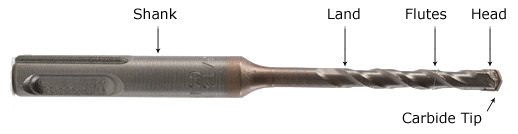
The SDS drill bit is made up of 5 parts.
- First, there is the shank, which has two sets of grooves (for a total of four grooves) that fit into the hammer drill collar. The smaller of the grooves are two slots that are not open at the end and prevent the bit from falling out. The larger of the grooves are two grooves that extend to the end of the shank and when chucked in the drill, guide the SDS bit to a positive rotation. This set of grooves also allows the bit to slide in the chuck, enhancing the drilling torque and hammering energy of the tool.
- The next component of the SDS bit is the land — which is the raised portion of the spiral (similar to the crest or peak of a wave).
- The third area is the flute or the trough section of the spiral. The flute facilitates the removal of the concrete dust as the hole is being drilled.
- The last two components of the SDS bit are the head and the carbide tip, which work together to break up the concrete. The carbide is brazed onto the head to harden the tip of the SDS bit to assist in the breaking of the concrete.
How is this type of drill bit used?
SDS bits are designed for use with a rotary hammer drill. The SDS bit is placed into the end of the drill and is held in place by twisting the chuck of the drill, locking the bit in the collar. The SDS masonry bit is not held solidly in the chuck of the drill but slides up and down like a piston. The slots in the shank of the SDS bit accept the two ball bearings in the spring loaded chuck of the hammer drill and will remain chucked until disengaged by the user.
The hammer drill should only be used in the hammering and rotation position when using an SDS bit to drill into concrete. The bit will both rotate and reciprocate at the same time. When the trigger is pulled on the hammer drill, a gear-driven crank moves a piston back and forth within the pneumatic chamber. The compressed air within the chamber propels the SDS carbide steel bit forward, delivering a concrete destroying impact. The use of an SDS drill bit in a hammer drill can drill a 3/4" diameter hole, 4" in depth, in about 30 seconds.
A good rotary hammer drill can drive an SDS bit into concrete without too much effort from the user. In most drilling application pushing harder on the drill will speed up the process. This is not the case with a hammer drill and SDS bit. The SDS bit is actually reciprocating and turning at the same time. Pushing down on the drill will only slow its progress and cause the bit to deteriorate faster.
When should an SDS carbide bit be used?
The SDS carbide tipped drill bit is used for two reasons. The first is to drill holes into concrete, brick or block for the installation of a concrete fastener. The second is to drill holes in concrete, brick or block to create a path for installing wiring and plumbing.
When using an SDS carbide drill bit to drill into a wall, it is important to support the weight of the hammer drill. If the drill does not receive the proper support, the bit itself will carry a portion of the weight. This may cause undue pressure on the flute of the bit possibly causing the drill bit to break in the hole.
Below is a chart indicating the available sizes and corresponding drilling depths for SDS carbide tipped drill bits.
| Bit Size |
Usable Length (or) Drilling Depth |
Bit Size |
Usable Length (or) Drilling Depth |
|---|---|---|---|
| 5/32" x 4-5/8" | 2" | 1/2" x 6-5/8" | 4" |
| 5/32" x 6-5/8" | 4" | 1/2" x 10-5/8" | 8" |
| 5/32" x 8-5/8" | 6" | 1/2" x 12-5/8" | 120" |
| 3/16" x 4-3/8" | 2" | 1/2" x 18-5/8" | 16" |
| 3/16" x 6-3/8" | 4" | 1/2" x 24" | 22" |
| 3/16" x 8-5/8" | 6" | 1/2" x 38" | 36" |
| 3/16" x 10-5/8" | 8" | 9/16" x 6-3/4" | 4" |
| 3/16" x 12-5/8" | 10" | 9/16" x 10-1/8" | 7-7/8" |
| 3/16" x 14-5/8" | 12" | 9/16" x 12-3/4" | 10" |
| 3/16" x 16-5/8" | 14" | 9/16" x 18-3/4" | 16" |
| 7/32" x 4-3/4" | 2-1/2" | 5/8" x 6-3/4" | 4" |
| 7/32" x 6-5/8" | 4" | 5/8" x 9-3/4" | 7" |
| 7/32" x 8-5/8" | 6" | 5/8" x 12-3/4" | 10" |
| 7/32" x 10-1/4" | 8" | 5/8" x 18-3/4" | 16" |
| 7/32" x 14-5/8" | 12" | 5/8" x 24" | 22" |
| 7/32" x 16-5/8" | 14" | 5/8" x 36" | 34" |
| 1/4" x 4-3/8" | 2" | 11/16" x 12-3/4" | 10" |
| 1/4" x 6-3/8" | 4" | 11/16" x 18-3/4" | 16" |
| 1/4" x 8-5/8" | 6" | 3/4" x 6-3/4" | 4" |
| 1/4" x 11-5/8" | 9" | 3/4" x 9-3/4" | 7" |
| 1/4" x 12-1/4" | 9-5/8" | 3/4" x 12-3/4" | 10" |
| 1/4" x 14-5/8" | 12" | 3/4" x 18-3/4" | 16" |
| 1/4" x 16-5/8" | 14" | 3/4" x 24" | 22" |
| 1/4" x 20-5/8" | 18" | 3/4" x 36" | 34" |
| 9/32" x 8-5/8" | 6" | 13/16" x 12-3/4" | 10" |
| 5/16" x 6-5/8" | 4" | 27/32" x 8-3/4" | 6" |
| 5/16" x 9-3/4" | 7-1/2" | 27/32" x 12" | 10" |
| 5/16" x 12-5/8" | 10" | 7/8" x 9-3/4" | 7" |
| 3/8" x 6-5/8" | 4" | 7/8" x 12-3/4" | 10" |
| 3/8" x 10-5/8" | 8" | 7/8" x 18-3/4" | 16" |
| 3/8" x 12-5/8" | 10" | 7/8" x 24" | 21" |
| 3/8" x 20-5/8" | 18" | 1" x 10-3/4" | 8" |
| 3/8" x 24" | 22" | 1" x 13-1/8" | 10-1/4" |
| 3/8" x 36" | 34" | 1" x 18-3/4" | 16" |
| 7/16" x 6-5/8" | 4" | 1" x 25" | 22" |
| 7/16" x 12-5/8" | 10" | 1" x 30" | 28" |
| 7/16" x 18-5/8" | 16" | 1-1/8" x 12-3/4" | 10" |
| 1-1/8" x 18-3/4" | 16" | ||
| 1-1/4" x 12-3/4" | 10" |
It is important not to drill a hole deeper than the intended drilling depth of the bit. This could cause an interruption in the dust removal and increase the amount of heat on the carbide tip. Heat build up on the carbide may melt the brazing material, allowing the carbide plate to move. This possibly could lead to the bit failing in breaking the concrete.
Some suggestions for increasing the life of your SDS drill bits:
- Before drilling, check to see that the carbide tip is in good shape.
- Inspect the connection to make sure that there is not excessive wear. This helps prevent the drill bits from getting stuck in the chuck.
- Lubricate the connection end of the bit to allow the bit shank to slide in the chuck. This is done by applying a small amount of grease to the grooves of the shaft (no more than a quarter inch dollop).
- Let the tool do the work. When used in a quality hammer drill, the SDS drill bit will cut into concrete with relative ease. Hold the drill level and apply pressure evenly throughout the hole drilling process.
The SDS shank is the most widely used shank type when drilling into concrete. The SDS shank has superb hammer performance, high torque transmission and the ease of one-handed, quick chucking operation.
Recent Posts
-
Best Masonry Anchors
Get the job done right the first time by using the best masonry anchors for the application. A mason …Nov 24th 2020 -
Best Cinder Block Fasteners
Fastening to Cinder Block Cinder block …Jun 16th 2020 -
Best Brick Anchors
Male or Female Anchor? Female anchors would require the spotting of the anchor and then place th …Feb 21st 2019