
Selection Guide
Below are descriptions and common names for the concrete fasteners that we carry. Use this to find the right fastener for your project. Click on the photo or name of the fastener to buy.

Concrete Wedge Anchor – Light to Heavy-duty concrete anchor/fastener for solid concrete base material.
Commonly called:
Wedge anchor, stud anchor, kwik-bolt, thunderstud, thunderstuds, wedge anchors, DFS wedge anchor, sup-r-stud, kwik bolt II anchor, Hilti kwikbolt, kwik bolt, concrete stud anchor, stud wedge anchor, stud anchor system, power bolt, power stud, trubolt, redi bolt, wedge all, kingpin
Description:
Two pieces, permanently pre-assembled into a single unit make up the ThunderStud® wedge anchor. A portion of the rod’s length is threaded and protected from damage by the rounded design of its extreme end. A necked down diameter that tapers outwardly to the full diameter of the rod makes up the other end. The unit has a carbon steel, precision formed universal clip permanently assembled around the necked down diameter. Packages of Thunderstud® Concrete Wedge Anchors always contain the correct number of nuts and washers. The Concrete Wedge Anchor is also available in hot-dipped galvanized and stainless steel.
Common variations and misspellings:
Quick bolt, thunder stud, super stud, quick bolt II anchor, powerbolt, powerstud, true bolt, ready bolt, king pin, superstud
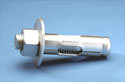
Concrete Sleeve Anchor – Light to Medium-duty concrete fastener/anchor for concrete, brick and block base material.
Commonly called:
Sleeve anchor, sup-r-sleeve, thunderbolt, bolt sleeve anchor, lok bolt, lock bolt, dynabolt, sleeve all, sleeve anchors, concrete anchor, masonry anchor
Description:
Each high-quality steel part of the Concrete Sleeve Anchor is zinc plated. A tubular expander sleeve is assembled over a threaded stud with an outwardly flared cone-shaped end. The anchor, which works on a true expansion principal, comes ready for use with nut and washer. The cone-shaped stud end is pulled into the expander sleeve as the nut is tightened. This wedges the expander sleeve outward and locks the anchor into the base material. The Concrete Sleeve Anchor is also available in stainless steel.
Common variations and misspellings:
Super sleeve, Super-Sleeve, Thunder bolt, lockbolt, dyna-bolt
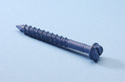
Tapcon® Concrete Screw Anchor – Light to medium-duty concrete fastener for concrete, brick and block base material.
Commonly called:
Tapcon®, concrete screw, self-tapping concrete screw, concrete screws, the original tapcon, con-sert screw, consert screw, confast screw, ruff-nex, kwik-con, tapper, titen, masonry screws, concrete and masonry screw
Description:
To provide exceptional holding power and stability, Tapcon® concrete screws are designed with alternating raised and lowered threads with diamond cut notches. Tapcon® brand concrete screws tap threads into a pre-drilled hole, and are available in both 3/16" and 1/4" diameters, with either a flat Phillips #3 countersunk or a 5/16" hex washer head. Large diameter Tapcons are available in diameters of 3/8” to 5/8”. Both the standard and large diameter Tapcons are also available in stainless steel.
Common variations and misspellings:
Self-tapping concrete screw, Tap Con, concert screw, con fast screw, rough necks, roughnecks, quick-con, quick con, titan, kwik con

Concrete Drop-In Anchor – Light to heavy-duty concrete anchor/fastener for solid concrete base material.
Commonly called:
Drop-in, drop-in, female anchor, HDI, Hilti drop-in anchor, concrete drop-in anchor, sup-r-drop, HDI anchor, lip drop in anchor, HDI-L anchor, HDI-P anchor, thunderdrop, multi-set concrete anchor
Description:
Drop-In Anchors are made of an expansion shield and an expander plug. The expansion shield is made of zinc-plated steel and has four equally spaced slots for a portion of its length. The bottom part of the shield may be knurled. The shield also has a smooth, flangeless top that allows either flush or countersunk installation. The expander plug is case hardened and tempered to prevent galling and binding during expansion. The inside of the anchor is threaded. The drop-in anchor needs to be set with a setting tool. Drop-in anchors are also available in stainless steel.
Common variations and misspellings:
Drop in anchor, hilti drop-in anchor, super drop, lip drop-in anchor, thunder drop
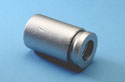
Concrete Machine Screw Anchor- Light to medium-duty concrete fastener for concrete, brick or block base material.
Commonly called:
Machine screw anchor, hollow wall anchor, as, machine screw anchors, sup-r-caulk, caulkin anchor, caulk-in anchor, thundertite, steel drop in, hollow set drop in, calk-in concrete and masonry anchor
Description:
The Machine Screw Anchor is made of a 100% rust proof, antimonial lead alloy sleeve and a zinc alloy (Zamac) internally threaded cone. The cone has a series of integral ribs or lugs which prevent the cone-shaped nut from turning in the sleeve. Anchors are pre-assembled into a single, self-contained unit. The machine screw anchor is expanded by the use of a setting tool.
Common variations and misspellings:
Super caulk, thunder tight, thunder tite, steel drop-in, hollow set drop-in, cawlk-in, cawlk in
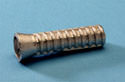
Concrete Leadwood Screw Anchor – Light-duty concrete anchor/fastener for brick, block and concrete base material.
Commonly called:
Leadwood screw anchor, sup-r-lead, wood screw lead anchors, screw lead, wood screw expansion anchor, LWSA, concrete, and masonry anchor
Description:
The Leadwood Screw anchor is designed so that it does not turn in the masonry during initial expansion. Made from Zamac, the Leadwood screw anchor is straight for the majority of its length, tapering outward from the anchor diameter into a cone. The majority of the straight section is split from the bottom up and has longitudinal ribs along this section. The tapered design facilitates proper expansion in the masonry. When the corresponding sheet metal screw is screwed into the anchor, the longitudinal ribs bite into the masonry, allowing the screw to form its own threads without twisting in the hole.
Common variations and misspellings:
Super lead, superlead, woodscrew

Concrete Single Expansion Anchor- Light to Medium-duty concrete anchor for block, brick and concrete base material.
Commonly called:
Single expansion anchor, single expansion shields, keystone single expansion shield, single wedge machine bolt, single, single thunderloc, SMSA, machine screw anchor, concrete, and masonry anchor
Description:
Single Expansion Anchors, made of a precision die-cast zinc alloy (Zamac), are recommended for shear loads or where the bolt is subjected to side pressure or vibration. They are made of a cone nut and a tubular shield that are pre-assembled into a single unit. The two-piece tubular shield contains a wedge-shaped cone nut at one end and is bound together with a spring band. The placement of integral lugs on the cone nut keep the wedges from turning in the shield during expansion. The expansion action at one end of the anchor distributes the anchored load throughout the length of the anchor.
Common variations and misspellings:
Thunder lock, thunderlock
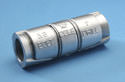
Concrete Double Expansion Anchor- Medium to heavy-duty concrete fastener for concrete, brick and block base material.
Commonly called:
Double expansion anchor, double expansion shield, keystone double, double thunderloc, double, DMSA, machine screw anchor, concrete, and masonry anchor
Description:
Double Expansion Anchors, made of a precision die-cast zinc alloy (Zamac), are recommended for shear loads or where the bolt is subjected to side pressure or vibration. They are made of a cone nut, a hollow cone and a tubular shield that are pre-assembled into a single unit. The two-piece tubular shield contains a wedge-shaped cone nut at one end, a wedge-shaped hollow cone at the other end and is bound together with a spring band. The placement of integral lugs on the cone nut and the hollow cone keep the wedges from turning in the shield during expansion. The expansion action at both ends of the shield distributes the anchored load throughout the length of the shield.
Common variations and misspellings:
Double thunder lock, double thunderlock

Concrete Lag Shield Anchor- Light to medium-duty concrete fastener for block, brick and concrete base material.
Commonly called:
Lag shield, lag screw shields, lag screw anchor, sup-r-lags, lag screw expansion anchor, LSES, concrete, and masonry anchor
Description:
The Concrete Lag Shield Anchor is a two-part expansion shield made of a zinc alloy commonly known as Zamac, a rust proof material.The shield comes in two lengths. The short lag shield is for anchoring in high-grade concrete or where the thickness of the base material prohibits the use of a longer length shield. The long lag shield is for use in lower grade base material or where extra anchoring strength is required. The design of the shell-like unit has tapered internal threads for a portion of its length that permit easy turning of the screw without lubrication. The outside of the anchor has a series of circumferential ribs starting at the bottom and running for a major portion of its length. The back end of the anchor has two equally spaced ribs that protrude beyond its diameter and run for a portion of its length. Fastened objects can be easily removed after being fastened.
Common variations and misspellings:
super lags, superlags
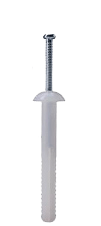
Concrete Nylon Nail-It Anchor – Light-duty concrete fastener for concrete, brick and block base material.
Commonly called:
Nylon nail-it, nail-it, nail it, strike anchor, mushroom head, nylon nail anchor, tap-its, impact anchor, thunder tap, nylon nail anchors, nylon nail in, concrete and masonry anchor
Description:
Made of injection molded, thermoplastic-formula polyamide resins, the Nylon Nail-It Anchor is comprised of a shank and a steel pin expander. In addition to a series of circumferential ribs running for a portion of its length, the shank is split from the bottom up for a majority its length. The anchor body has a concentric cavity or bore, which runs through the head thickness and into the shank for a depth just beyond the point where the slit terminates in the body. The steel pin expander, made of properly heat treated, high carbon steel, is heavily plated with bright zinc and differs from a nail because of a specially designed thread it has a section of its shank and because it has a screwdriver slot in the head. It has maximum corrosion resistance. The specially designed threads and head on the expander pin lock the assembly.
Common variations and misspellings:
Tap it anchors, tap its, thunder tap, nylon nail-in
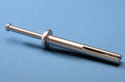
Concrete Metal Hit Anchor- Light-duty fastener for concrete, brick and block base material.
Commonly called:
Metal hit anchor, zamac anchor, strike anchor, nail anchor, roof anchor, hammer drive anchor, thundernail, hammer drives, zamac hammer screw, zamacs, zamac nailin, hammer set, concrete, and masonry anchor
Description:
This precision die-cast Metal Hit anchor is made of a cylindrical zinc alloy body and a zinc-plated steel pin expander. Made of carbon steel, the pin expander has been properly heat-treated and heavily zinc plated so that it has maximum corrosion resistance. Its shank is split from the bottom up for a majority of its length. The body has a bore, which runs through the head thickness and into the shank for a depth just past the point where the slot terminates the body.
Common variations and misspellings:
Thunder nail, Zamac nail-in
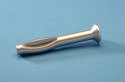
Concrete Split Drive Anchor- Light-duty concrete fastener for concrete base material.
Commonly called:
Split anchor, split drive anchor, flat head split anchor, round head split anchor, split bolt anchor, super-split, split drive anchors, spike, drive, CSD, countersunk split drive anchor, concrete, and masonry anchor
Description:
Manufactured with hardened, heat-treated carbon steel, Split drive anchors are available with a flat, countersunk head or a rounded head. There are two sheared, pre-expanded halves at the base of the anchor that is compressed as the anchor are driven into the concrete. The anchor exerts tremendous force on the inside walls of the hole as the two halves continually try to regain their original shape. This positive expansion compensates for poor grade or old concrete. Concrete Split Drive anchors have low “slip” rates and increased vibration resistance.
Common variations and misspellings:
Super split

Concrete Strike Anchor- Medium to heavy-duty concrete anchor for solid concrete base material.
Commonly called:
Strike anchor, all American anchor, hit anchor, nail anchor, all anchor, EZA, easy set expansion anchor, concrete, and masonry anchor
Description:
The body of the Concrete Strike Anchor is carbon steel coated with yellow dichromate over zinc plating. It has an interior hole that extends the length of the anchor. The anchor is threaded on the top where the drive pin is inserted (the drive pin comes inserted in the interior hole of the anchor). The opposite end of the anchor has four slots that are equally spaced and ribs that extend the circumference of the anchor, both which run a portion of its length.
Common variations and misspellings:
EZ set expansion anchor